

(Gemini illustration)
Until sunset today is the Day of Atonement.
In the original Hebrew, the Bible calls the day Yom Hakippurim (which is Hebrew for “Day of the Atonements”).
Notice a ceremony related to the Day of Atonement is discussed in Leviticus 16:
8 … Aaron shall bring the goat on which the Lord’s lot fell, and offer it as a sin offering.
15 Then he shall kill the goat of the sin offering, which is for the people, bring its blood inside the veil, do with that blood as he did with the blood of the bull, and sprinkle it on the mercy seat and before the mercy seat. 16 So he shall make atonement for the Holy Place, because of the uncleanness of the children of Israel, and because of their transgressions, for all their sins; and so he shall do for the tabernacle of meeting which remains among them in the midst of their uncleanness. 17 There shall be no man in the tabernacle of meeting when he goes in to make atonement in the Holy Place, until he comes out, that he may make atonement for himself, for his household, and for all the assembly of Israel. 18 And he shall go out to the altar that is before the LORD, and make atonement for it, and shall take some of the blood of the bull and some of the blood of the goat, and put it on the horns of the altar all around. 19 Then he shall sprinkle some of the blood on it with his finger seven times, cleanse it, and consecrate it from the uncleanness of the children of Israel. (Leviticus 16:8, 15-190
The slain goat symbolically represents Jesus.
Christ’s sacrifice is an atonement sacrifice to reconcile us to God. Notice what the Apostle Paul wrote:
18 Now all things are of God, who has reconciled us to Himself through Jesus Christ, and has given us the ministry of reconciliation, 19 that is, that God was in Christ reconciling the world to Himself, not imputing their trespasses to them, and has committed to us the word of reconciliation. (2 Corinthians 5:18-19)
Notice also something from the Hebrew scriptures:
6 In mercy and truth
Atonement is provided for iniquity;
And by the fear of the Lord one departs from evil. (Proverbs 16:6)2 O You who hear prayer,
To You all flesh will come.
3 Iniquities prevail against me;
As for our transgressions,
You will provide atonement for them. (Psalm 65:2-3)
Jesus died for our iniquities (for more on prophecies about Jesus check out the free online book: Proof Jesus is the Messiah).
Notice that this was clearly prophesied in the Hebrew scriptures:
1 Who has believed our report? And to whom has the arm of the Lord been revealed? 2 For He shall grow up before Him as a tender plant, And as a root out of dry ground. He has no form or comeliness; And when we see Him, There is no beauty that we should desire Him. 3 He is despised and rejected by men, A Man of sorrows and acquainted with grief. And we hid, as it were, our faces from Him; He was despised, and we did not esteem Him.
4 Surely He has borne our griefs And carried our sorrows; Yet we esteemed Him stricken, Smitten by God, and afflicted. 5 But He was wounded for our transgressions, He was bruised for our iniquities; The chastisement for our peace was upon Him, And by His stripes we are healed. 6 All we like sheep have gone astray; We have turned, every one, to his own way; And the Lord has laid on Him the iniquity of us all. 7 He was oppressed and He was afflicted, Yet He opened not His mouth; He was led as a lamb to the slaughter, And as a sheep before its shearers is silent, So He opened not His mouth. 8 He was taken from prison and from judgment, And who will declare His generation? For He was cut off from the land of the living; For the transgressions of My people He was stricken. (Isaiah 53:1-8)
And it came to pass.
Jesus was the atonement:
10 And love consists in this: not that we loved God, but that He loved us and sent His Son as the atoning sacrifice for our sins. (1 John 4:10, BSB)
25 God presented Him as the atoning sacrifice through faith in His blood, in order to demonstrate His righteousness, because in His forbearance He had passed over the sins committed beforehand. (Romans 3:25, BSB)
7 In Him we have redemption through His blood, the forgiveness of sins, according to the riches of His grace (Ephesians 1:7, NKJV)
28 Therefore take heed to yourselves and to all the flock, among which the Holy Spirit has made you overseers, to shepherd the church of God which He purchased with His own blood. (Acts 20:28, NKJV)
10 This is love: not that we loved God, but that he loved us and sent his Son as an atoning sacrifice for our sins. (1 John 4:10, NIV)
Notice also:
6 For when we were still without strength, in due time Christ died for the ungodly. 7 For scarcely for a righteous man will one die; yet perhaps for a good man someone would even dare to die. 8 But God demonstrates His own love toward us, in that while we were still sinners, Christ died for us. 9 Much more then, having now been justified by His blood, we shall be saved from wrath through Him. 10 For if when we were enemies we were reconciled to God through the death of His Son, much more, having been reconciled, we shall be saved by His life. 11 And not only that, but we also rejoice in God through our Lord Jesus Christ, through whom we have now received the reconciliation. (Romans 5:6-11)
11 And not only so, but we also joy in God through our Lord Jesus Christ, by whom we have now received the atonement.
12 Wherefore, as by one man sin entered into the world, and death by sin; and so death passed upon all men, for that all have sinned …
17 For if by one man’s offence death reigned by one; much more they which receive abundance of grace and of the gift of righteousness shall reign in life by one, Jesus Christ. (Romans 5:11-12, 17, KJV)
Jesus was an atonement for us to reconcile us to God.
God loved us and sent Jesus:
16 For God so loved the world that He gave His only begotten Son, that whoever believes in Him should not perish but have everlasting life. 17 For God did not send His Son into the world to condemn the world, but that the world through Him might be saved. (John 3:16-17)
Jesus did not just die for the elect. The sacrifice of the goat during the Atonement ceremony helps picture that.
In this age, however, only some are being called:
26 For you see your calling, brethren, that not many wise according to the flesh, not many mighty, not many noble, are called. (1 Corinthians 1:26)
5 Even so then, at this present time there is a remnant according to the election of grace. (Romans 11:5)
But God wants everyone saved:
1 Therefore I exhort first of all that supplications, prayers, intercessions, and giving of thanks be made for all men, 2 for kings and all who are in authority, that we may lead a quiet and peaceable life in all godliness and reverence. 3 For this is good and acceptable in the sight of God our Savior, 4 who desires all men to be saved and to come to the knowledge of the truth. 5 For there is one God and one Mediator between God and men, the Man Christ Jesus, 6 who gave Himself a ransom for all, to be testified in due time (1 Timothy 2:1-6).
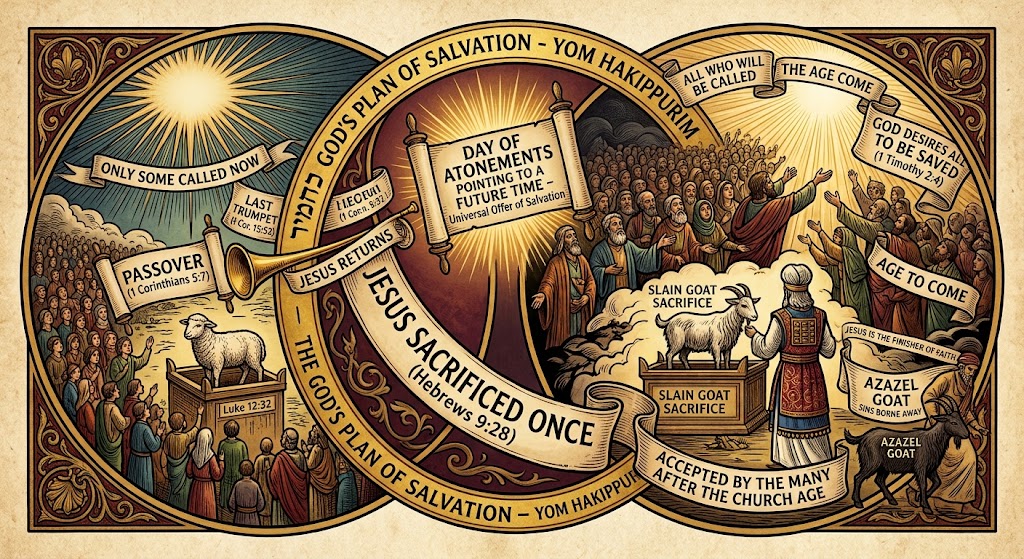
Since saving all is God’s desire and the Bible teaches only some are called now (see the free book Is God Calling You?), and that God is NOT a respecter of persons (Acts 10:34, KJV), surely God’s plan includes those NOT called in this age (see also the free book Universal OFFER of Salvation, Apokatastasis: Can God save the lost in an age to come? Hundreds of scriptures reveal God’s plan of salvation). The showing of Jesus as the slain goat in the ancient Day of Atonement ceremony, after the end of the church age, pictures that.
In the New Testament, the Apostle Paul also shows that:
7 … For indeed Christ, our Passover, was sacrificed for us. (1 Corinthians 5:7)
Paul wrote that Jesus was the Passover sacrificed for Christians.
of tYet, Paul also wrote that Jesus was only sacrificed once for our sins in Romans 6:10, Hebrews 7:27, Hebrews 9:12, Hebrews 9:28, and Hebrews 10:10. Let’s look at one of those passages.:
28 … Christ was offered once to bear the sins of many. To those who eagerly wait for Him He will appear a second time, apart from sin, for salvation. (Hebrews 9:28)
Consider that since Jesus was our Passover lamb sacrificed for us (1 Corinthians 5:7-8) and He only was slain once (Hebrews 9:28), we also see a ceremony on the Day of Atonement other than Passover where Jesus is ceremonially slain, but this time represented as a goat.
Why two sacrifices since Jesus was only sacrificed once?
Because of how the biblical holy days picture God’s plan of salvation.
The original Passover only resulted in the children of Israel being passed over for their sins. In this age, those who are true Christians claim the sacrifice of Jesus, the Lamb of God, on His final earthly Passover for paying the penalty for our sins. Like the ancient children of Israel, real Christians are a small minority of the population of the world (Luke 12:32; cf. Romans 11:5).
Since God’s desire is for all to be saved and come to the knowledge of truth, we see Jesus sacrifice pictured twice in the biblical holy days. The Holy Days picture God’s plan of salvation. From the start of the Christian church in Acts 2 to present, we have been in what can be called the ‘church age.’
This age lasts until Jesus returns, which He does on the seventh and last trump (1 Corinthians 15:52), which is one of the trumpets pictured by the Feast of Trumpets. After the church age is over, Jesus’ sacrifice will be accepted by more than the elect of the church age. It is NOT because Jesus will get sacrificed again.
Jesus is the “author and finisher of our faith” (Hebrews 12:2). Passover shows is part of why He is the author and the Day of Atonement helps show us He is the finisher (as does His return with the last trumpet on pictured by the Feast of Trumpets).
So, although the Greco-Roman-Protestants tend to think the atonement was just a past event, this understanding of the Day of Atonement points to a future time–and shows an aspect of God’s plan of salvation that most seem to have missed.
As Christians, this picturing of Jesus as the goat of the atonement also shows us that we are not ‘better’ than others (cf. 1 Corinthians 1:26-31) and that although we are the ones who have accepted Jesus’ Passover sacrifice now, others will accept His atoning sacrifice later (see also Universal OFFER of Salvation, Apokatastasis: Can God save the lost in an age to come? Hundreds of scriptures reveal God’s plan of salvation).
In the Old Testament the high priest entered the most holy place once per year on the Day of Atonement. However, as mentioned earlier, Jesus only needed to do that once:
23 Therefore it was necessary that the copies of the things in the heavens should be purified with these, but the heavenly things themselves with better sacrifices than these. 24 For Christ has not entered the holy places made with hands, which are copies of the true, but into heaven itself, now to appear in the presence of God for us; 25 not that He should offer Himself often, as the high priest enters the Most Holy Place every year with blood of another — 26 He then would have had to suffer often since the foundation of the world; but now, once at the end of the ages, He has appeared to put away sin by the sacrifice of Himself. 27 And as it is appointed for men to die once, but after this the judgment, 28 so Christ was offered once to bear the sins of many. To those who eagerly wait for Him He will appear a second time, apart from sin, for salvation. (Hebrews 9:23-28)
Jesus’ second appearance will not only bring salvation to Christians, but will bring the possibility of salvation to others that were not called in the church age (see also Universal OFFER of Salvation, Apokatastasis: Can God save the lost in an age to come? Hundreds of scriptures reveal God’s plan of salvation).
Since the Bible calls Satan “the god of this age” who has “blinded” the world (2 Corinthians 4:4), they have been blinded and have not yet been covered by the sacrifice of Jesus, but this will happen for all who will be called–either in this age or the age to come (Matthew 12:32; Mark 10:30; Luke 18:30; cf. Acts 3:21; see also Universal Offer of Salvation: There Are Hundreds of Verses in the Bible Supporting the Doctrine of True Apocatastasis). Showing the sacrifice, ceremonially, after the church age ends, helps show that the sacrifice of Jesus was not just for those called in the church age.
By showing the sacrifice prior to the other goat being released, this also shows that Jesus was not taking away the sins of Satan.
Now consider something that John the Baptist said about Jesus:
29 The next day John saw Jesus coming toward him, and said, “Behold! The Lamb of God who takes away the sin of the world! 30 This is He of whom I said, ‘After me comes a Man who is preferred before me, for He was before me.’ 31 I did not know Him; but that He should be revealed to Israel, therefore I came baptizing with water.” (John 1:29-31)
Jesus took the penalty of all human beings.
Jesus’ sacrifice doesn’t apply to individual humans until after God calls and grants each one of us repentance (John 6:44) and we come to be willing to repent and we come to believe (regarding God’s calling, check out the free online book: Is God Calling You?). Not only in Jesus, but we believe the Son and we believe the Father, that is, we believe what They say. Also, we prove it by repenting, being baptized, being granted the Holy Spirit (Acts 2:38) and actually trying to live as They would have us live (cf. 1 John 2:6).
The Passover shows that.
But Jesus came to take away the sins for more than simply the elect called in this church age. Now consider that the Day of AtonementS happens after the end of the church age. For the seventh trumpet associated with the Feast of Trumpets is the close of the church age.
The Day of Atonement pictures Jesus being the atoning goat sacrifice, therefore, for all who will be offered salvation after Jesus returns.
This is a truth that is proclaimed by the Continuing Church of God.
Suggested Holy Day Services
Here is a suggested Day of Atonement service for our scattered brethren and other interested people:
- 2-3 hymns (our songbook, The Bible Hymnal, contains the materials from the 1974 Bible Hymnal from the old WCG with new covers, plus ten additional hymns; there is also some Choral Accompaniment online).
- Opening prayer.
- Offertory: The Day of Atonement Offering.
- Announcements (if any) and one hymn.
- The suggested sermon, which for most who receive this letter via email, will be a recorded one. The suggested one is titled: From Atonement to Jubilee: Liberation.
- Final hymn.
- Closing prayer.
Here is a suggested Day of Atonement service for our scattered brethren and other interested people who prefer to have two services:
- 2-3 hymns (our songbook, The Bible Hymnal, contains the materials from the 1974 Bible Hymnal from the old WCG with new covers, plus ten additional hymns; there is also some Choral Accompaniment online).
- Opening prayer.
- Sermonette: Love Others.
- Announcements (if any) and one hymn.
- The suggested sermon is: The Meaning of Atonement.
- Final hymn.
- Closing prayer.
Those who have more interest may wish to study the following:
The Meaning of Atonement That was the title of a sermon by Herbert W. Armstrong gave on September 20, 1980. The article is based on that and has been expanded with updates and additional scriptures. Here is a link to a related sermon video: The Meaning of Atonement.
The Day of Atonement–Its Christian Significance The Jews call it Yom Kippur, Christians “The Day of Atonement.” Does it have any relevance for Christians today? What is the Jubilee? Is fasting healthy? Here is a link to a sermon: Day of Atonement: How Jesus fulfilled His part for the Atonement. Here is a link to a related article in the Spanish language: El Día de Expiación –Su significado cristiano.
Is God Calling You? This booklet discusses topics including calling, election, and selection. If God is calling you, how will you respond? Here is are links to related sermons: Christian Election: Is God Calling YOU? and Predestination and Your Selection. A short animation is also available: Is God Calling You?
Christian Repentance Do you know what repentance is? Is it really necessary for salvation? Two related sermons about this are also available: Real Repentance and Real Christian Repentance.
The Atonement Plan How does the Day of Atonement tie into God’s plan of salvation? Two sermons of related interest are available God’s Atonement and Fasting Plan and God’s Atonement Plan.
Atonement Offertory Should an offering be taken up on the Day of Atonement? What does the Bible seem to teach about that? Was Jesus a type of atonement offering? If you send an offering, how does that support the work? Does God need your money or do you need to give? Dr. Thiel goes over scriptures and facts related to this. Here is a link to the donation page of the Continuing Church of God, which includes the ability to use PayPal: http://www.ccog.org/donations/
Michael’s Feasts and Fasts Quiz 15 questions, amusing wrong answer screens.
Michael’s Day of Atonement Quiz Another free on-line Bible quiz by my son Michael.
Michael’s Feasts and Fasts Quiz 15 questions, amusing wrong answer screens.
Should You Observe God’s Holy Days or Demonic Holidays? This is a free pdf booklet explaining what the Bible and history shows about God’s Holy Days and popular holidays.
Importance of Fasting An old article by Herbert W. Armstrong on this subject. Here is a link to it in Mandarin Chinese 禁食的重要性.
Did Early Christians Observe the Fall Holy Days? The ‘Fall’ Holy Days come every year in September and/or October on the Roman calendar. Some call them Jewish holidays, but they were kept by Jesus, the apostles, and their early faithful followers. Should you keep them? What does the Bible teach? What do records of church history teach? What does the Bible teach about the Feasts of Trumpets, Atonement, Tabernacles, and the Last Great Day? Here is a link to a related sermon: Should Christians keep the Fall Biblical Holy Days?
The Book of Life and the Feast of Trumpets? Are they related? Is so how? If not, where not? What does the Feast of Trumpets, which the Jews call Rosh Hashanah, help teach? A related sermon video would be Feast of Trumpets and the Book of Life as well as The Trumpet Release. The article has links to hear shofar blasts.
Feast of Trumpets: Why Should You Keep It? What does the Bible say? What does this festival picture?
Jesus: The Son of God and Saviour Who was Jesus? Why did He come to earth? What message did He bring? Is there evidence outside the Bible that He existed? Here is a YouTube sermon titled Jesus: Son of God and Saviour.
Proof Jesus is the Messiah This free book has over 200 Hebrew prophecies were fulfilled by Jesus. Plus, His arrival was consistent with specific prophecies and even Jewish interpretations of prophecy. Here are links to seven related sermons: Proof Jesus is the Messiah, Prophecies of Jesus’ birth, timing, and death, Jesus’ prophesied divinity, 200+ OT prophecies Jesus filled; Plus prophecies He made, Why Don’t Jews Accept Jesus?, Daniel 9, Jews, and Jesus, and Facts and Atheists’ Delusions About Jesus. Plus the links to two sermonettes: Luke’s census: Any historical evidence? and Muslims believe Jesus is the Messiah, but … These videos cover nearly all of the book, plus have some information not in the book.
Universal OFFER of Salvation, Apokatastasis: Can God save the lost in an age to come? Hundreds of scriptures reveal God’s plan of salvation Will all get a fair chance at salvation? This free book is packed with scriptures showing that God does intend to offer salvation to all who ever lived–the elect in this age, and the rest in the age to come. Here is a link to a related sermon series: Universal Offer of Salvation 1: Apocatastasis, Universal Offer of Salvation 2: Jesus Desires All to be Saved, Mysteries of the Great White Throne Judgment (Universal Offer of Salvation part 3), Is God Fair, Will God Pardon the Ignorant?, Can God Save Your Relatives?, Babies, Limbo, Purgatory and God’s Plan, and ‘By the Mouth of All His Holy Prophets’.
Holy Day Calendar This is a listing of the biblical holy days through 2033, with their Roman calendar dates. They are really hard to observe if you do not know when they occur  In the Spanish/Español/Castellano language: Calendario de los Días Santos. In Mandarin Chinese: 何日是神的圣日? 这里是一份神的圣日日历从2013年至2024年。.